
In many parts of Africa, especially in Nigeria, grid instability and frequent outages remain a major barrier to industrial productivity. On average, factories only receive 6-10 hours of reliable grid electricity per day from this source, forcing businesses to depend heavily on backup generators for energy delivery.
Dependence on continuous power can result in production losses, equipment wear and increased operational risk for manufacturing operations that rely on uninterrupted electricity. By pairing an energy storage system with existing photovoltaic (PV) generation capacity, factories can switch from an unreliable energy environment to a fully off-grid power source solution.

The factory faced unreliable grid access, with frequent outages and voltage fluctuations disrupting continuous production. Reliance on diesel generators increased costs and operational complexity. Although a PV system was already in place, the lack of energy storage prevented full utilization of solar power and a stable supply during non-generating hours, limiting true energy independence.
SCU provided containerized energy storage system, BRES-720-375, designed to integrate seamlessly with existing solar infrastructure. It stores any excess solar power generated during the day and releases it at night or low generation periods, creating a fully off-grid operation using intelligent energy management techniques.

Installing energy storage produced immediate and measurable improvements. Power continuity was restored, eliminating downtime caused by grid failures. More significantly, however, diesel consumption was drastically decreased; using typical industrial generator efficiency (0.25-0.3 liters per kWh), this meant offsetting approximately 180-215 liters daily of diesel consumption when fully utilized; at an estimated daily diesel cost of $1-$1.2 per liter in Nigeria this led to daily savings between $180-$250 or roughly $65,000-$90,000.
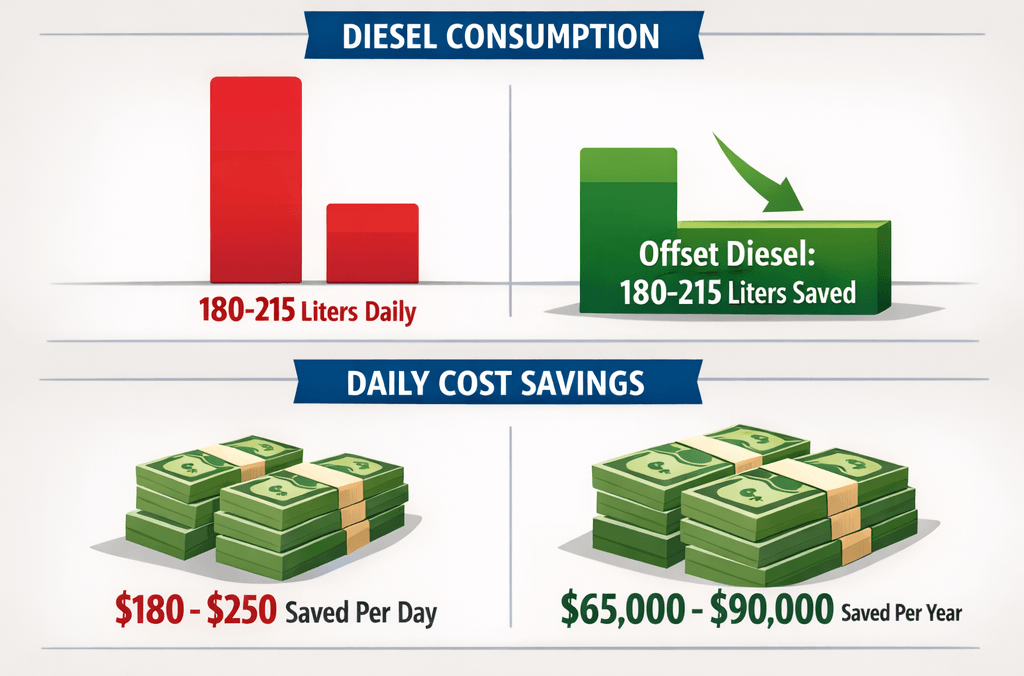
With these savings, an investment in a large battery energy storage system typically achieves a payback period between three and five years, depending on usage patterns, fuel price fluctuations, system integration considerations, and system integration costs. Beyond direct cost savings, energy storage solutions also stabilize production, reduce maintenance requirements, and significantly decrease generator runtime by lowering carbon emissions.
Off-grid solar battery storage systems offer businesses in regions with weak or unreliable grids a scalable route towards industrial energy independence. By combining solar generation and battery energy storage, businesses can secure reliable power, reduce exposure to volatile fuel prices, and gain long-term cost predictability.
As energy issues persist across African markets, integrated solar battery storage has become an essential infrastructure element for sustainable industrial growth and operational resilience.